



The need for Halo
There’s been a cry in the industry for years and across countries: media fragmentation requires improved reach&frequency measurement. Not only that: that new measurement should be used/embraced/agreed ¹ by all the parties participating in the advertising ecosystem, should be neutral, open, adaptable, locally adaptable…
Halo is the industry’s response to that need. It’s more of a technical framework than an organizational blueprint, but its birth has opened a window of opportunity to refresh measurement systems across the world.
Understanding the framework
All the documentation from Halo is open sourced. There’s a very complete GitHub page (link) and in key document (link) describes the framework in detail.
Halo is really smart. It’s a privacy-centric solution to put the 1P data of each advertising platform to work in harmony with the other pieces of the puzzle (audience panels…). As public and open as it is, it’s also extremely difficult to understand and really hard to explain when going into the details.
Halo is not necessarily a single-source panel for x-media. It’s a way of doing x-media with and/or without single-source, it’s more of a way of pooling all data sources together.
Therefore, it’s heavily reliant on modeling. It’s the only way to do it, but it decreases explanability. Either the marketers will believe or they won’t. Hard to trace what’s going on in case of data discrepancies.
In other words, it’s a solution that combines the best of audience panels with the scale 1P census data, using double-blind technologies.
As cool and smart as it is, Halo is still just reach&frequency reporting: an intermediate metric. Potentially better data feed for MMM, but still just an intermediate metric. Future of measurement is results-oriented measurement.
The framework applied: UK and USA
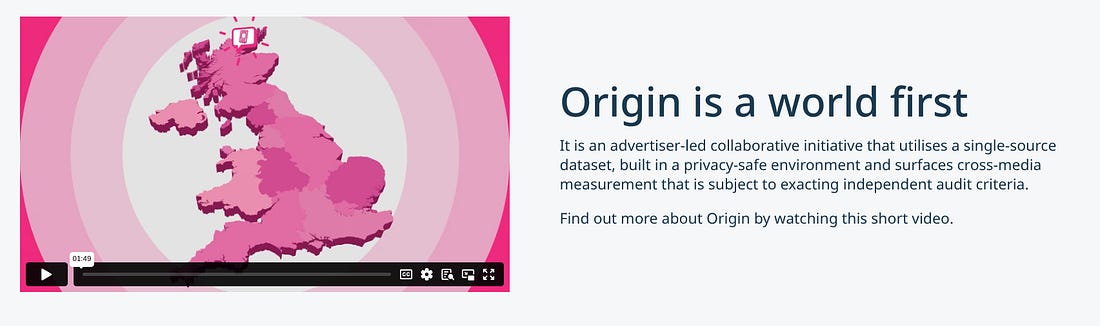
There are two projects that are executing this framework: one in UK (Origin) sponsored by ISBA and one in the USA (Aquila) sponsored by ANA. Most of the big tech platforms are participating in them. Kantar Media is running the consumer panel fueling both projects, while Accenture is providing the tech layer.
The UK successfully completed their Beta trials in July 2025 and transitioned into an "Expanded Availability" phase. Real, deduplicated cross-media campaign data is actively being surfaced and utilized by their funding advertisers and agencies.
Project MAPA in Spain
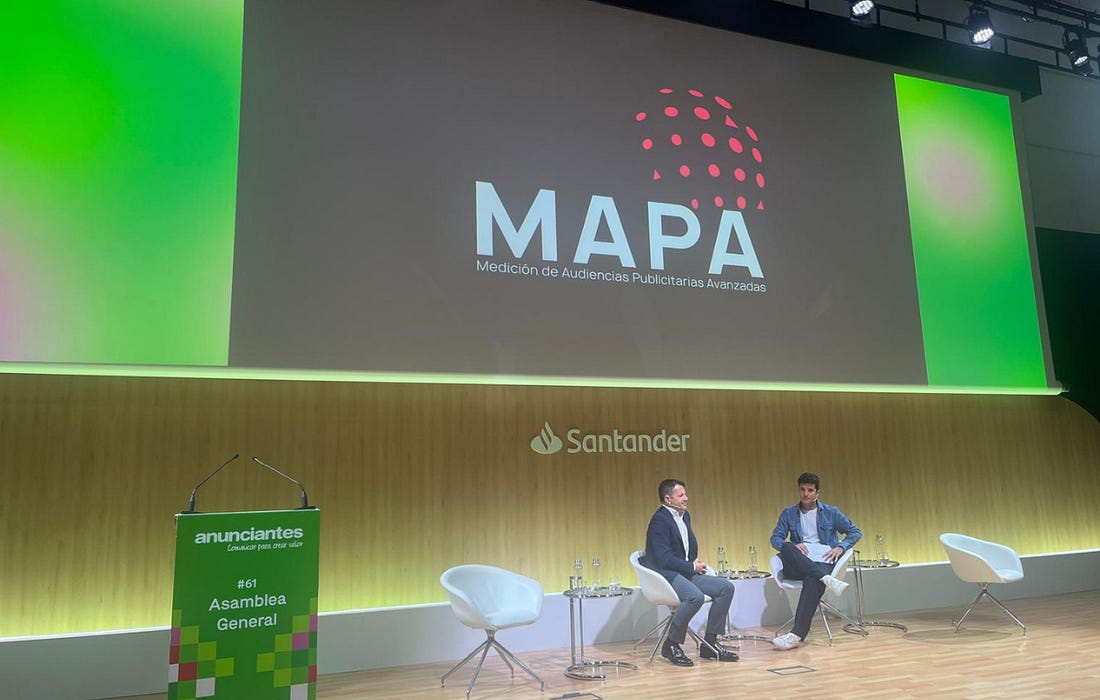
On April 29th the Spanish Advertiser Association announced project MAPA (Medición de Audiencias Publicitarias Avanzadas). So far the technical details have not been shared, but the intention is to develop a Halo project in the Spanish market. A working group will be set up during this 2026 with the idea of launching a MVP next year.
Beyond Halo: Audience Project
Are there non-halo alternatives to crossmedia measurement? Of course there are, each one with pros and cons.
For its relevance in a big market as France, we can highlight Audience Project. It is a turnkey solution that has presence in several countries and recently got a partnership with Mediametrie (link).
How much does this solve anyway?
Whereas solving x-media reach&frequency measurement is a great progress, it’s far from what a holistic measurement framework needs. Ultimately reach&frequency are intermediate metrics. What matters is incremental revenue, ROI, acquisitions.
On a secondary level, Halo is designed to measure “traditional” ways of delivering advertising impact. More and more we are seeing different ways of partnerships of content creators with brands. These may or may not be part of a Halo measurement, and it creates a blind spot.
Industry Updates
Marketing beef
Recently, there’s been an unusually high level of public debate on the marketing sphere. Dear reader, see it yourself, below you have all the links:
After System1 published “The Creative Dividend”, there was reaction from Byron Sharp published in Marketing Week and a response from the author in The Drum
Mark Ritson study with Ipsos identified gaps of knowledge among marketers (The Drum) bringing some conversation and reactions (main one)
Something going on with Nielsen’s Gauge in the USA (link, link).
What do we learn? 1) It’s good to talk, always. Even debate is good, means that at least people take things seriously. 2) Balance useful knowledge with good-enough data, often perfect is enemy of good. After all, we are here to run business, not to get the Nobel prize.
Meridian Training videos
Google has launched a series of training videos on Meridian. They are short and don’t go into technical details, but are interesting as outreach material.
The Meridian family is growing
Google’s GML has arrived with a large amount of launches in the measurement area, specially around Meridian. All of them will be available soon
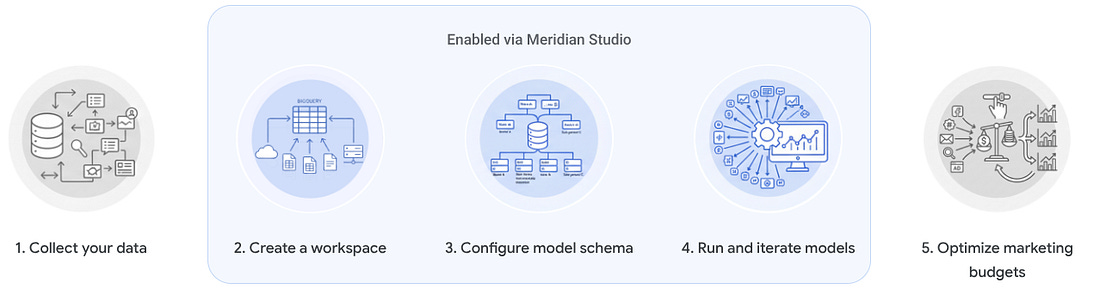
Meridian Studio is a platform to build, manage, and customize Meridian in Google Cloud. You can now run an MMM without worrying about your environment. It is more accessible but the model's calibration quality still depends entirely on what you feed it: clean spend data by channel, at least two years of history, and ideally an experiment per major channel. A no-code interface doesn't fix a poorly designed MMM.
Meridian in Google Analytics takes this further, providing MMM as a Google Analytics 360 feature, which after some configuration and data pipelines, would be always one click away from your traffic reports. If you are interested in adopting Modern Measurement features in Google Analytics 360, fill this form.
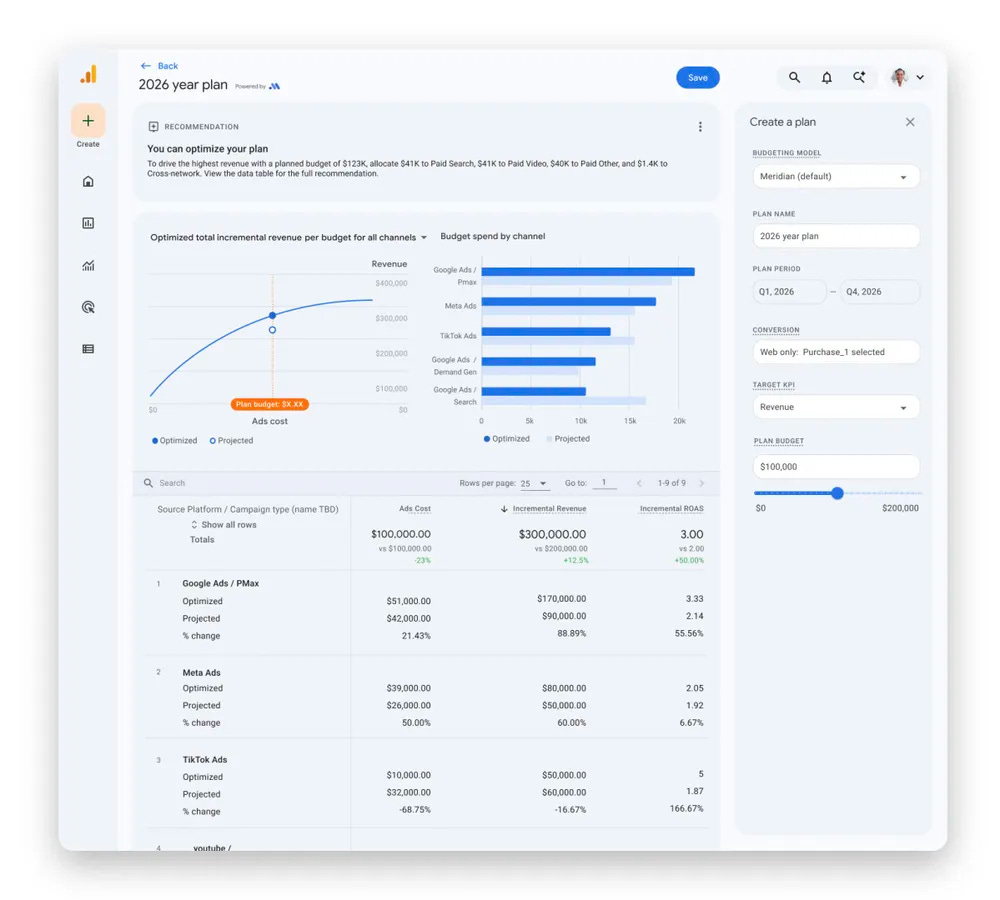
Meridian GeoX is the long awaited update to Google’s open source Geo Experiments methodology which we have covered in the past. It’s Google’s geo-holdout experiment design and analysis tool, built to calibrate Meridian models, with multi-cell capabilities, budget efficient and open for everyone. Read more about it here and you can sign up to receive updates from the Meridian team
Chart of the week
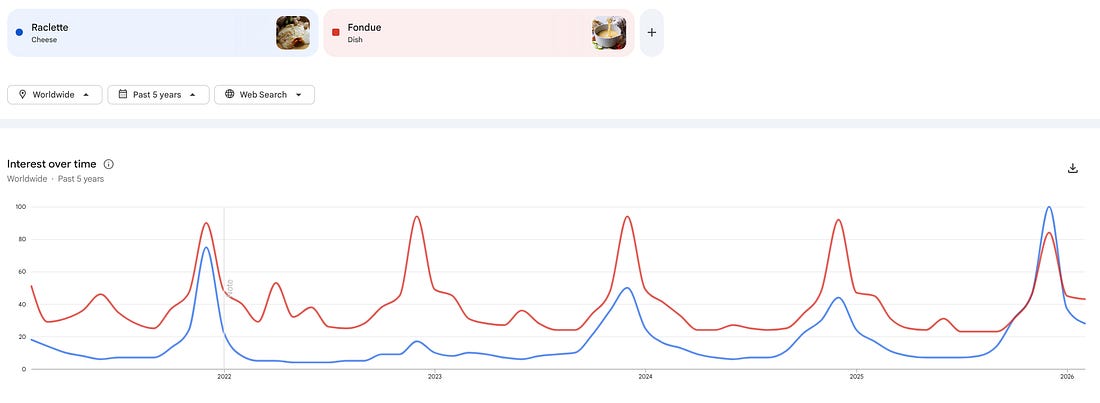
Raclette has taken over Fondue in the last years. Thanks SkipAds (link) for the tip and the sociological explanation!
Oldies but goldies
The relationship between reach, frequency and advertising effectiveness has been in the ground for a long time,
In 1979, Michael Naples published "Effective Frequency: The Relationship Between Frequency and Advertising Effectiveness" for the ANA (full original text available here), and in doing so canonised the "3+ frequency" rule as the operational KPI of the entire advertising industry for decades. The idea was straightforward: below three exposures per buying cycle, the ad doesn't work; above that threshold, it does. Beyond 10, excessive exposure.
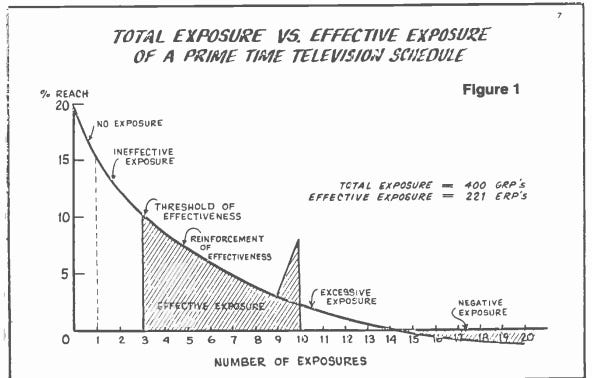
The problem is that number came from TV-only studies, in a single-medium world, with rudimentary measurement panels and no real ability to deduplicate cross-media exposure. For 45 years the industry has optimised reach & frequency against that benchmark, and still does, without ever knowing for certain whether impressions overlap across platforms or whether the "3+" threshold means anything in an ecosystem fragmented across 15 channels. Halo implementations are, in part, the long-overdue attempt to answer that question with data Naples never had.
As easy as it is to simplify this article into “let’s do 3+”, there is a much more important conclusion which we would like to highlight here:
General principles will be helpful in leading the way, but the fact remains that each brand is unique; therefore, to maximize advertising effectiveness, each should receive experimentation designed to determine its own frequency -of -exposure response function. In this way it is possible to set up a basis for sound media planning
Michael Naples, 1979
You can also ask the competitors to experiment for you and follow their success path, but results will be very different. Stay experimenting!
Note the different verbs here. Halo is the tech/framework that enables the measurement. The extent of the aplication of the framework, who runs it, who is part of it… That’s for each country local ecosystem to decide. Most agents in the advertising ecosystem would agree that some common understanding and measurement is desirable, but that’s beyond what Halo is about. It’s important to understand the differences, as in many countries the conversations on evolving measurement are being linked (tech and organization) but Halo is mostly about the tech.