There’s no doubt that creator marketing is on the rise. Advertisers want to collaborate with them to reach their audiences (not only young!), digital platforms keep on launching products to facilitate partnerships… We are seeing more and more campaigns and money flowing into the system.
Heterogeneity to the next level
However, these types of marketing executions have specificities that create unique measurement challenges. The root cause is the heterogeneity of the possible brand-creator executions. “Vanilla” TV or Digital Video is pretty homogeneous in terms of production and ad serving: a more or less professional video gets shot in some kind of standard format (6s bumper, 20s TV…), then ad placements get purchased (in the middle of a TV show or as part of the ad-sections of digital platform) and the ad is served to consumers. Even those campaigns that feature celebrities are pretty standard in terms of measurement: it’s just a different execution where the ad happens to have a famous person.
That is not the case for creator marketing. The main reason? On top of being a subset of the possible types of celebrities that we can choose to advertise, creators can reach consumers via their own means, on the different platforms where they operate, both organically and paid.
Let’s look at examples:
On this Santander ad we have the YouTuber called Plex. Is this creator marketing? Well… it’s a creator… inside an ad. If this ad appears on the ad break of TV or in a YouTube pre-roll, one would hardly affirm that this is creator marketing. It’s just an ad with a specific kind of celebrity, like it’s always been.
But then we have the same YouTuber collaborating with McDonald’s and launching a special product. Have a look at the ad below. Is this creator marketing? Well, getting closer, but it still resembles “an ad with a celebrity”. The distinction may come not on the piece itself, but on where the piece is stored and how it’s served. Is it hosted in the YouTuber channel and served organically? Or is the advertiser boosting the impressions by purchasing ad placements?
But what about when the same YouTuber shoots a 30 minutes video about the whole product? Hard to argue this is not creator marketing, specially when it’s hosted on the creator’s channel.
And what about the UGC that was created (“earned”) after the brand collaboration? Is it part of the same campaign?
Net: there are endless variations of executions and formats. Taken to the extreme, we even have some campaigns playing “meta” on creator marketing, borrowing names of famous creators as in this campaign of a student dorm. Is this creator marketing?

A measurement challenge
In a nutshell, measuring ROI is about comparing how much business was created by the impacts of the campaign vs. the cost of that campaign.
This is really clear on TV or Digital video: one knows how many GRPs/Impressions were seen by consumers, using MMM or Experiments one can determine the impact on sales. With that, you compare with the cost. But wait, which cost? The convention is that one includes the cost of running the campaign (purchasing the GRPs/impressions) but does NOT include the cost of shooting the ad. Same goes to any overhead (on the advertiser or the agency): it’s not part of the usual calculation. Right or wrong, does not really matter: there’s a criterion and it’s commonly accepted.
Therefore, one can compare the ROI campaigns across time, brands, countries… Because one can imagine what went into the calculations.
But what happens with creator campaigns?
First of all, on the impression side you need to have clarity on what is and is not included. Do we count only the paid impressions? The organic ones? Or also the earned ones? But that’s only the beginning, as the format of the impressions is possibly very different: do we add all of them together? do we make some kind of weighting? Do we break the different impression types of the campaign into different variables of our model?
Secondly, about the cost. What’s included or not? The cost of shooting the piece? The fee of the creator? A proportion of the agency overhead? The ad placements? Since creator campaigns are so versatile, so will cost drivers be. Heterogeneity will be the norm.
How to proceed
Can creator campaigns be measured? Surely yes: they are just another way of serving impressions to consumers. If there’s enough scale on the campaign, we should be able to observe an impact in our MMMs and our experiments.
The question is: how do we judge success or failure of those campaigns? What’s the ROI and is it better than other investment alternatives? That is when it becomes trickier, as we are introducing comparability.
Measurement and cost allocation imply a lot of decisions and conventions. It’s about aiming for consistency: across time, brands… Otherwise we can’t compare apples to apples.
If consistency can’t be achieved, then it’s about being transparent. The criteria should be discussed, aligned and in the models and the results reporting. Otherwise it’s going to be a source of dispute in the future.
Back to the business questions
Good research is always about driving decisions. So, let’s focus on some typical questions that marketing teams are trying to answer these days.
Do “creator campaigns” work better than “the old ones”?
Extreme care should be exercised when answering this business question. Everyone on the team should be aware of what’s accounted (or not). Is it really fair to include the creator fee in the ROI calculation when for a traditional ad we don’t add the cost of shooting it? One can always argue one way or another: but transparency is key.
What surely makes no sense is to talk about “The ROI of creator marketing”. It makes sense to talk about “the results of the campaign we ran with creator X with Y details on the execution”.
This question has deep practical implications too. On traditional media buys, if there’s a good ROI, then we can put more money on the table and scale that channel. That’s not that evident with creator campaigns. One can’t execute +25% increase on creator marketing budgets and expect they are going to behave as in a MMM response curve. It simply does not work like that.
What the business is really asking is: should we do a new creator campaign next year, and if so, how? Then the central question is about the creative idea: can it be equal or better than the one we measured?
Should we work with many small creators of fewer bigger ones?
Very complex question because the true cost of launching a campaign has to do also with the pain of coordinating all the creators (negotiating fees, egos…). Fortunately, today there are tools to make this process more scalable and with lower friction (most digital platforms are launching some kind of “creator shop”). We don’t have a strong POV on one or another, but from a measurement perspective this should be approached with care as there is huge heterogeneity here at play.
Should we support the campaign with paid advertising?
The answer is yes, you should. It’s 2026: we are past the idea of free organic reach, with creators or without them. Just help your business and invest some money in advertising. These days all digital platforms have some kind of media buys that help on these specific cases.
Industry Updates
Google’s “Effectiveness Equation - Part 2”
Google has just published a 67 pages whitepaper on effectiveness. It contains a wealth of data points based on extensive meta-analysis, but not only that. There’s an exhaustive practical appendix dealing with recommendations on how to measure price elasticity, long term ROI or creative impact. Download it here.
Byron vs. Ritson talk at Cannes
We were not there but here’s the summary by Andrew Tindall (link).

Google’s Meridian reached 2.0 and the Meridian family grew
Lots of exciting news for those open source marketing measurement enthusiasts out there, where new tools have arrived to the hands of those with Python knowledge. If you are eager to test new methodologies from one of the most relevant marketing measurement labs, you should check out Meridian. It starts from the research but also it is the result of the hands on practice of working with the most demanding advertisers in the world.
What are we talking about? Let’s first welcome the new kid in the Meridian family. Meridian GeoX.
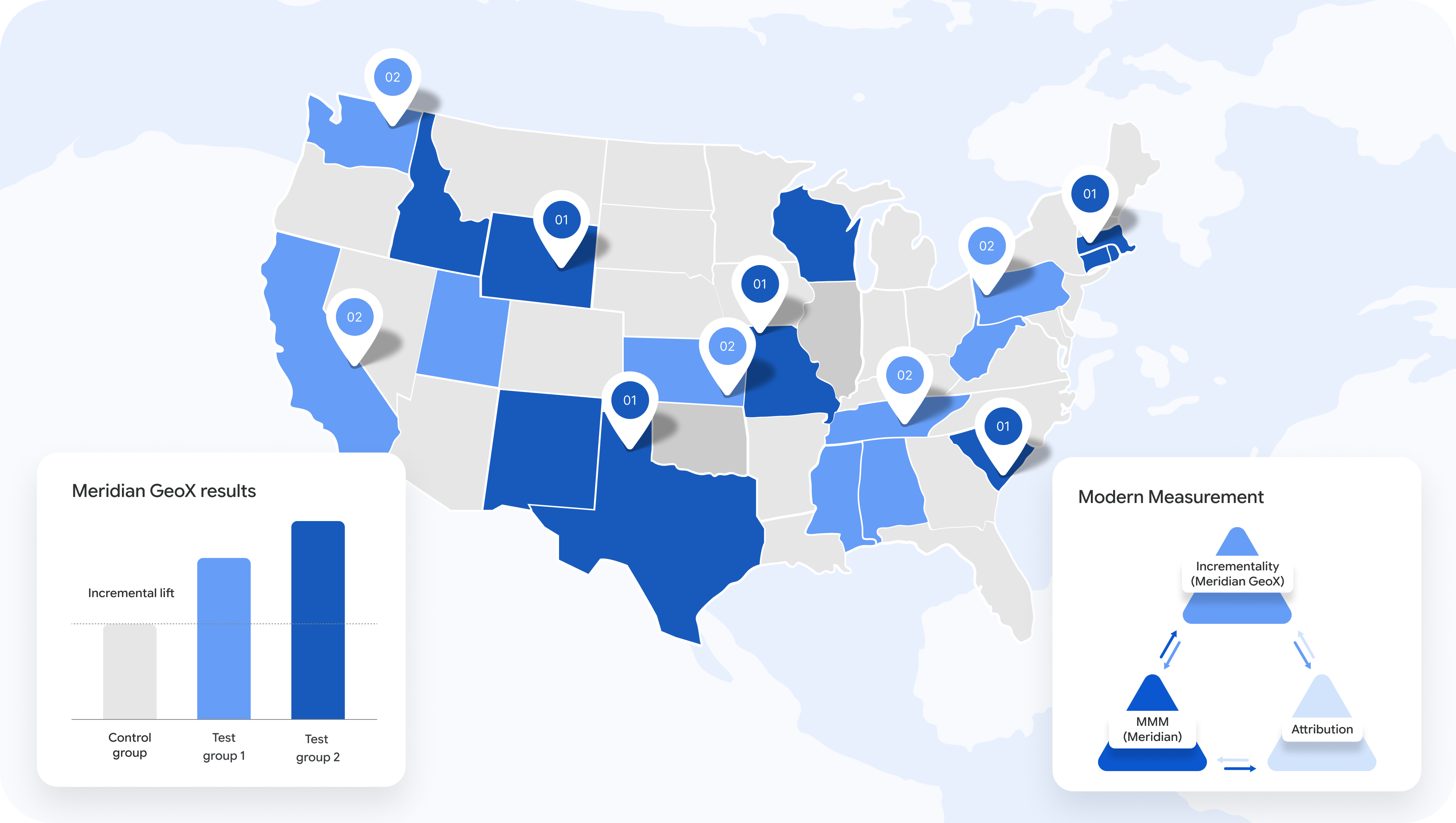
Meridian GeoX is a Python library which consolidates different incrementality methodologies to provide a single route for holdback, go-dark, heavy-up, multi-cell, flexible and MMM calibration ready results. If these buzzwords didn’t ring a bell, find someone in your team who is able to qualify the marketing measurement weapon that is available to anyone working with a proper coding agent for data analysis. Claude Code, Codex, Antigravity or even Gemini in Codelab are great tools to get a sense of what this tool is capable of and integrate it in your measurement workflows.
Next big news from the Meridian family, its MMM transitioned to version 2.0 featuring many advancements. What we found more interesting is the new ability to incorporate long term effects of media by unifying upper-funnel and lower-funnel measurement. Branded Google Query Volume (bGQV) to the rescue again! Virality is not such a thing when you have people searching for your brand, product or category after they saw an ad, driving the intent to buy in a clear way. And now you can incorporate that in Meridian, which effectively results in a nested model, more variables to control and definitely more insights to obtain. Along with this advancement, other breaking changes are worth noticing because some code will need review. Check it out!
Byron vs. Ritson at CMO Uncensored
Taking the opportunity of having these two heavyweights together, Jon Evans interviewed them on his YouTube show.
Chart of the week
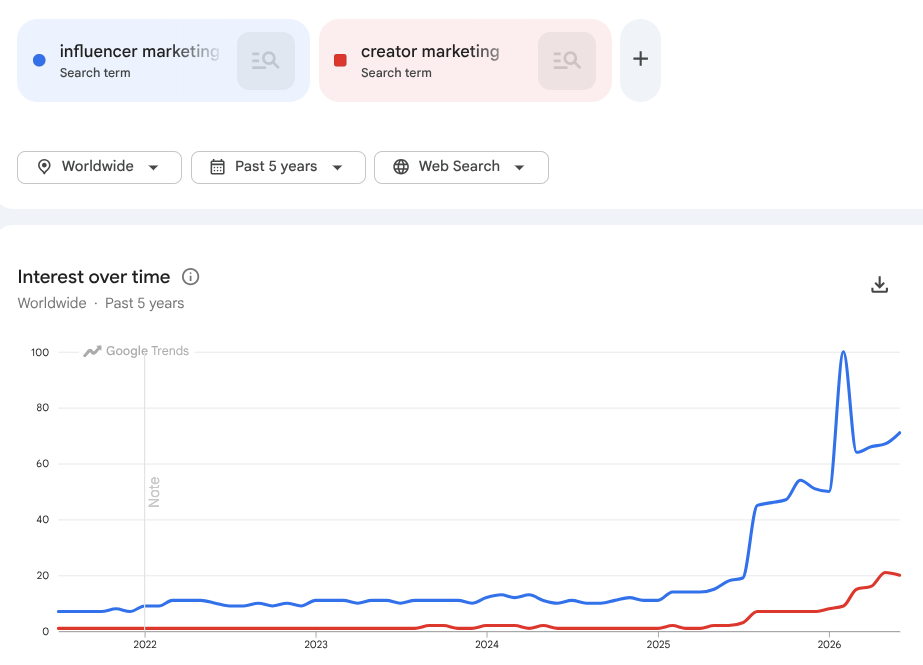
Should we say “creator marketing” or “influencer marketing”. Only time will tell…